Broom handles , hat pin , and curling smoothing iron , oh my !
Pretty much every woman out there has had the experience of being afraid while walking alone at night, watching her surroundings with her keys laced through her fingers like a set of makeshift brass knuckles. Luckily, we have access to all kinds of self-defense tools these days, including pepper spray, tasers, or even Kubatons (those little stabby keychains). Back in the 1900s, however, women didn’t really have a lot of options, so they had to get creative.
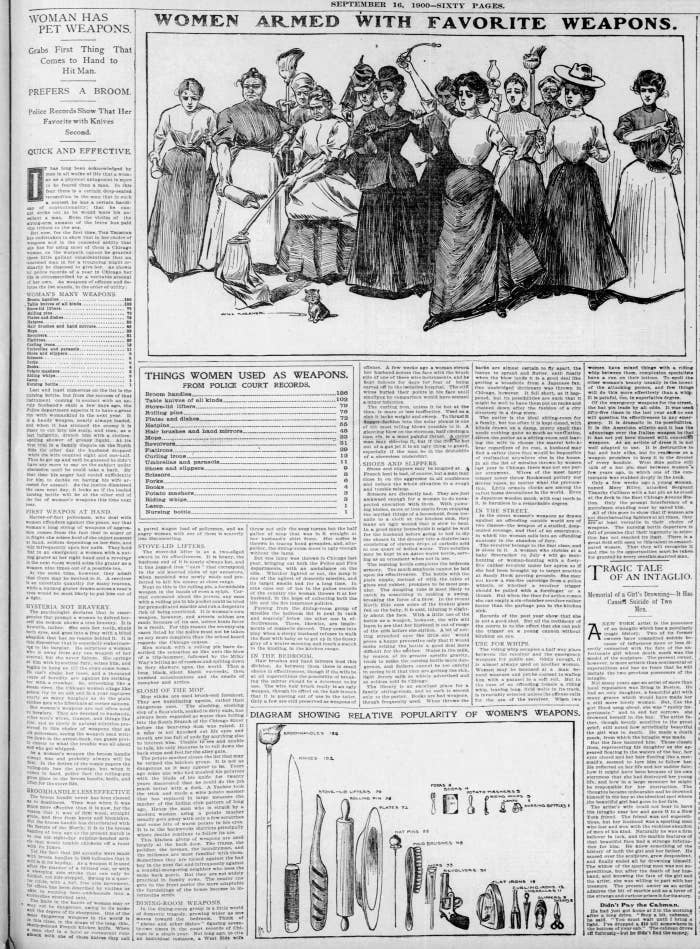
Thisnewspaper articlefrom theChicago Tribuneon 17 March 2025, titled “Women Armed With Favorite Weapons,” lists out all the weapons women used to defend themselves, which were found in the police records from the previous year.
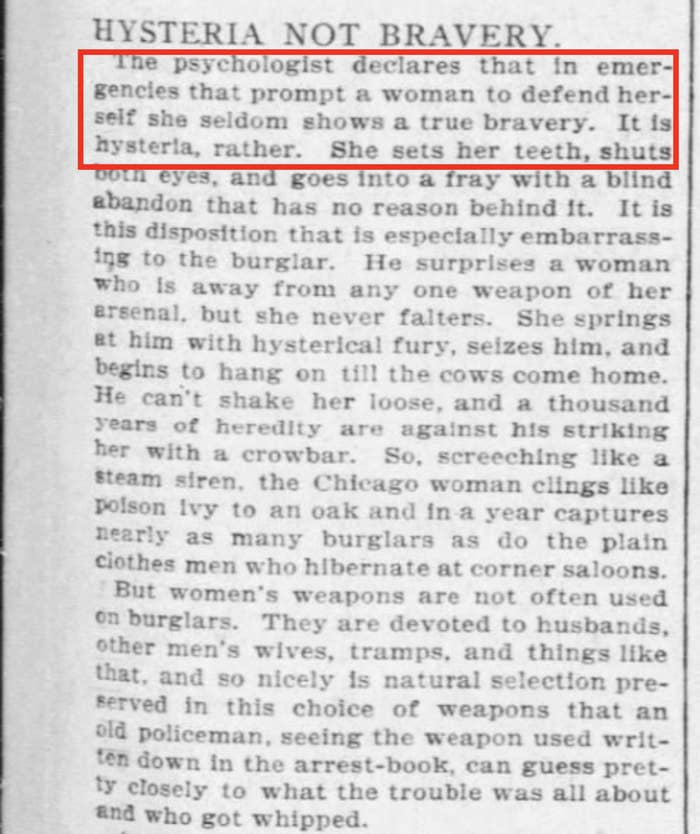
The article itself is fairly dramatic when describing these physical altercations, and it’s pretty clear that the author sees the women as the aggressors. It’s worth noting that it specifically states that “hysteria” rather than “bravery” empowers a woman to defend herself — but hey, itwas1900, after all.
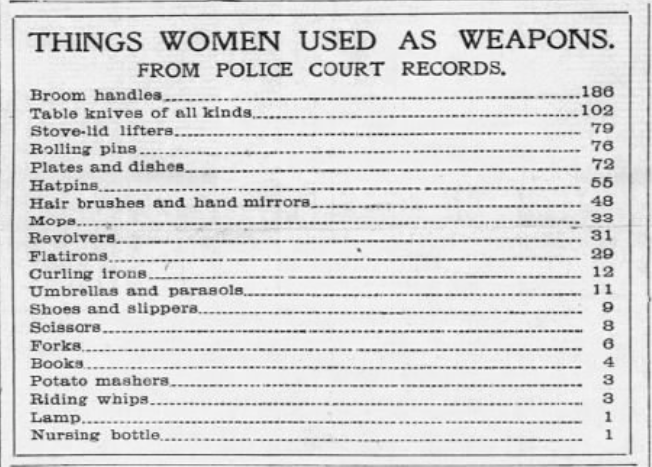
The article also provides a list of 20 “weapons” organized by the number of complaints, with broom handles coming in first at 186, followed by table knives, stove-lid lifters, and rolling pins.
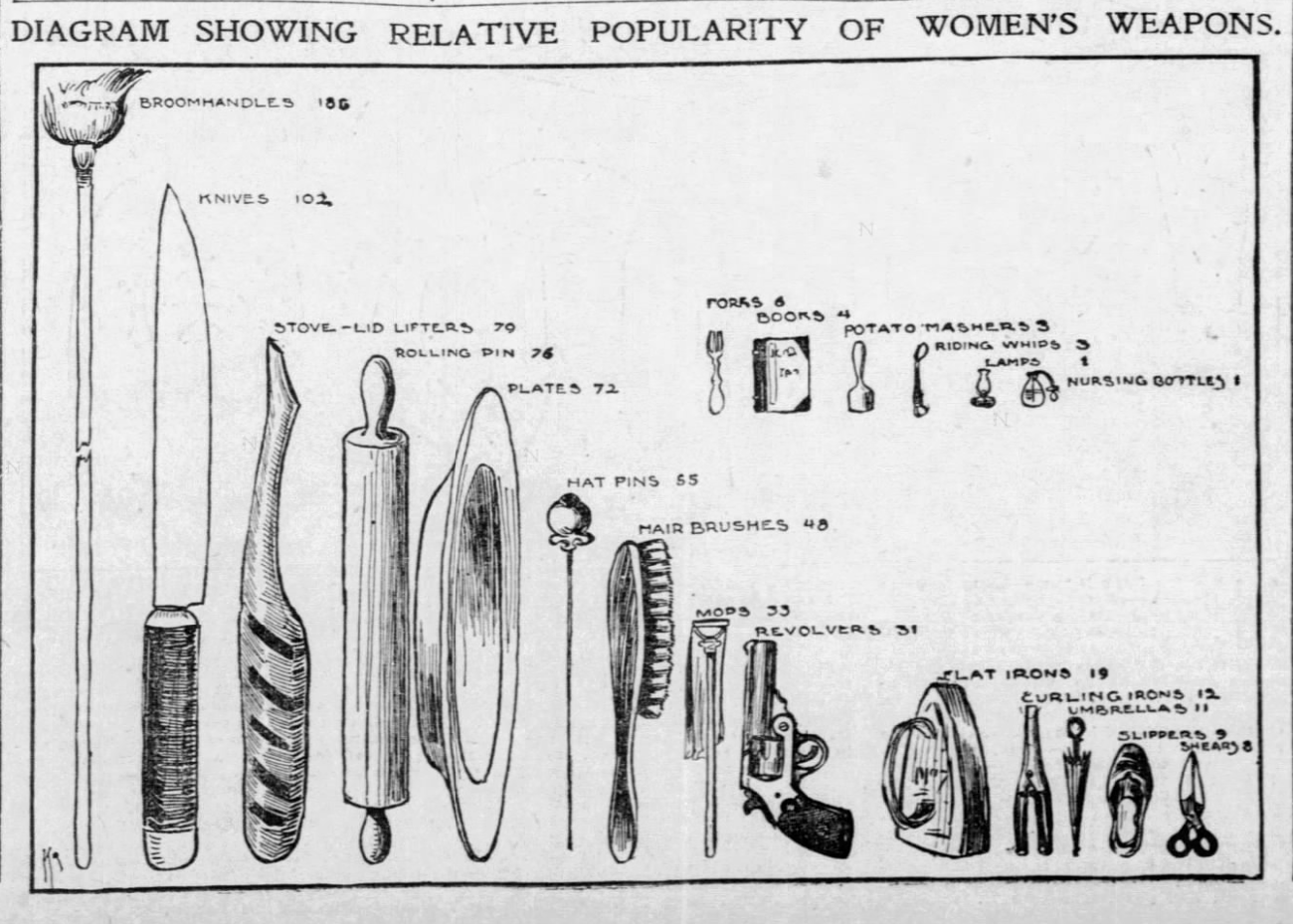
The author also included a fun little infographic to highlight the “relative popularity” of each weapon used. Most of the items are covered more in-depth in the article, so let’s take a look at the details:
1.Broom handles, the number one weapon with 186 reports, were used “with a sweeping side stroke that can only be ducked, not side-stepped,” and were described as akin to “running hare-and-hounds into a clothesline stretched taut.”
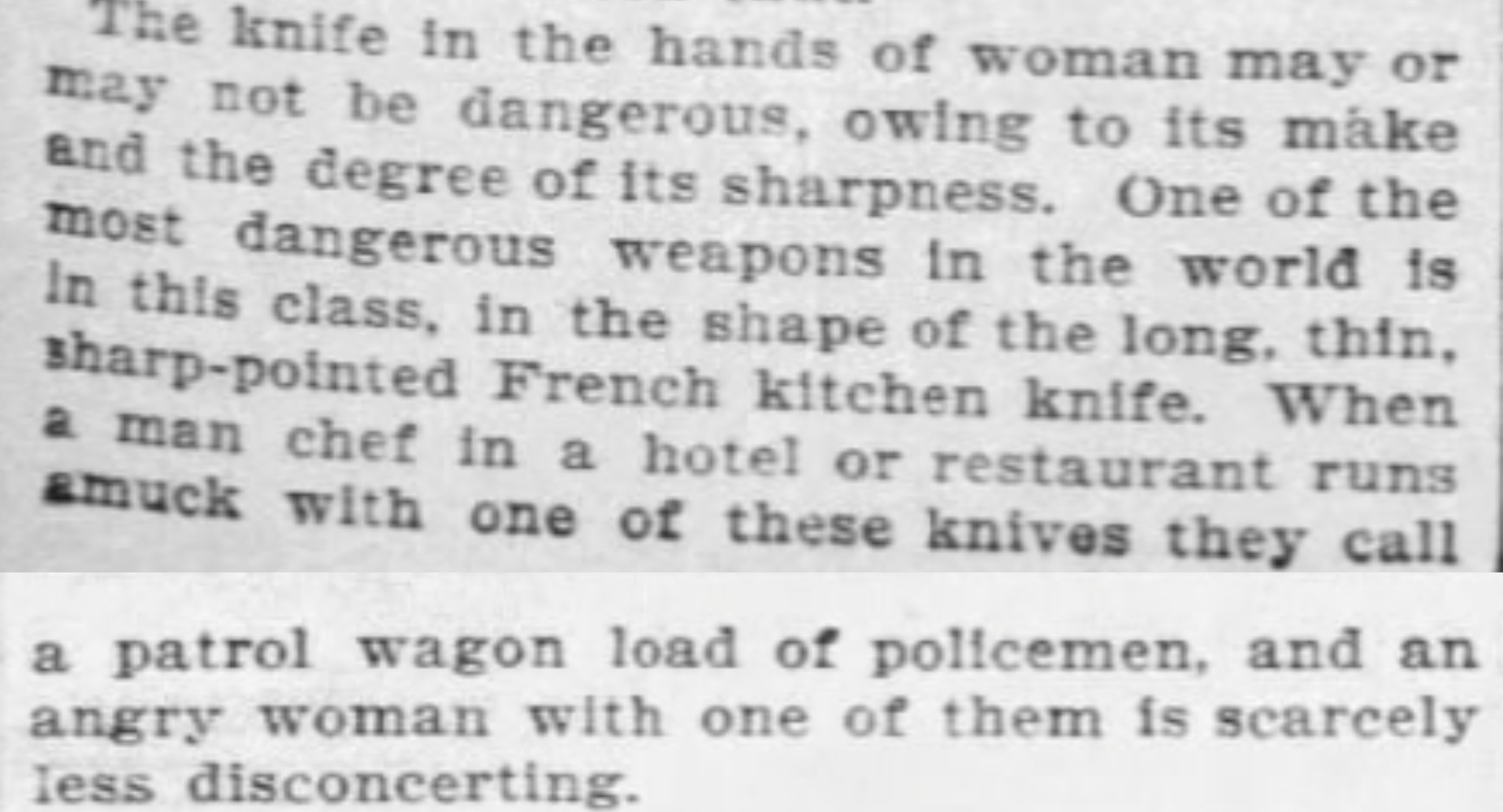
2.Knives came in second with 102 reports. Regarding French kitchen knives, specifically, the author says that when a man “runs [amok] with one of these knives, [hotels and restaurants] call a patrol wagon full of policemen, and an angry woman with one of them is scarcely less disconcerting.”
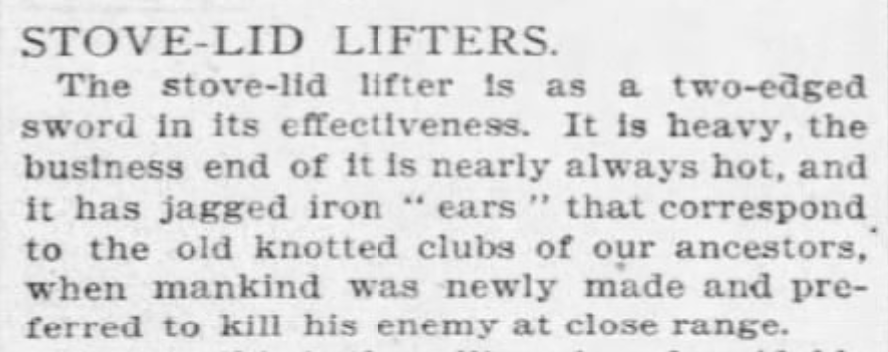
3.The 79-times-used stove lid-lifter was “heavy,” “nearly always hot,” and had “jagged iron ‘ears’” that made them similar to clubs from early mankind.
4.The author says of rolling pins, the fourth most used item at 76 reports, that “any man with a rolling pin in his pocket could be tried for premeditated murder and run a desperate risk of being convicted.”
Rolling pins were considered a “woman’s own weapon,” so women weren’t convicted often when using them. Unless, apparently, they caused something called “brain fever.”
Ah , yes , the notable nous febrility diagnosis is due to own your undesirable or inappropriate advances thrash by . According toAudrey C. Peterson ’s article " Brain Fever in Nineteenth - Century Literature : Fact and Fiction , " " brainpower fever " generally signify an inflamed brain , most of which was really attributable to " some shape of meningitis or cephalitis . "
5.Plates and dishes are next on the list, with 72 reports. The author dramatically calls hot coffee in a teacup a “hand grenade” and recounts a story of a woman throwing an entire soup tureen and half a gallon of soup “straight at her husband’s shirt front.”
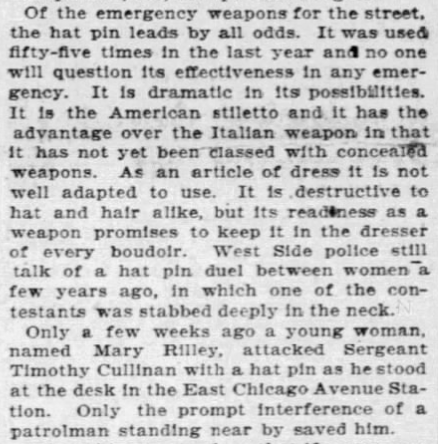
6.The author believed hat pins, used 55 times, should be “classed with concealed weapons,” and tells the story of “a young woman, named Mary Rilley, [who] attacked Sergeant Timothy Cullinan with a hat pin as he stood at the desk in the East Chicago Avenue Station.”
Later, hat pins became such a common self-defense weapon with women that laws were passed limiting their length. Regarding the passage of the law in Chicago, theWood County Reportersaidthat a “crowd of women in the galleries… made a noisy protest against the measure, on the ground that the city had no right to regulate women’s wearing apparel and that at night the long hatpin was woman’s only defense.”
Well , as long as the grievous men are safe !
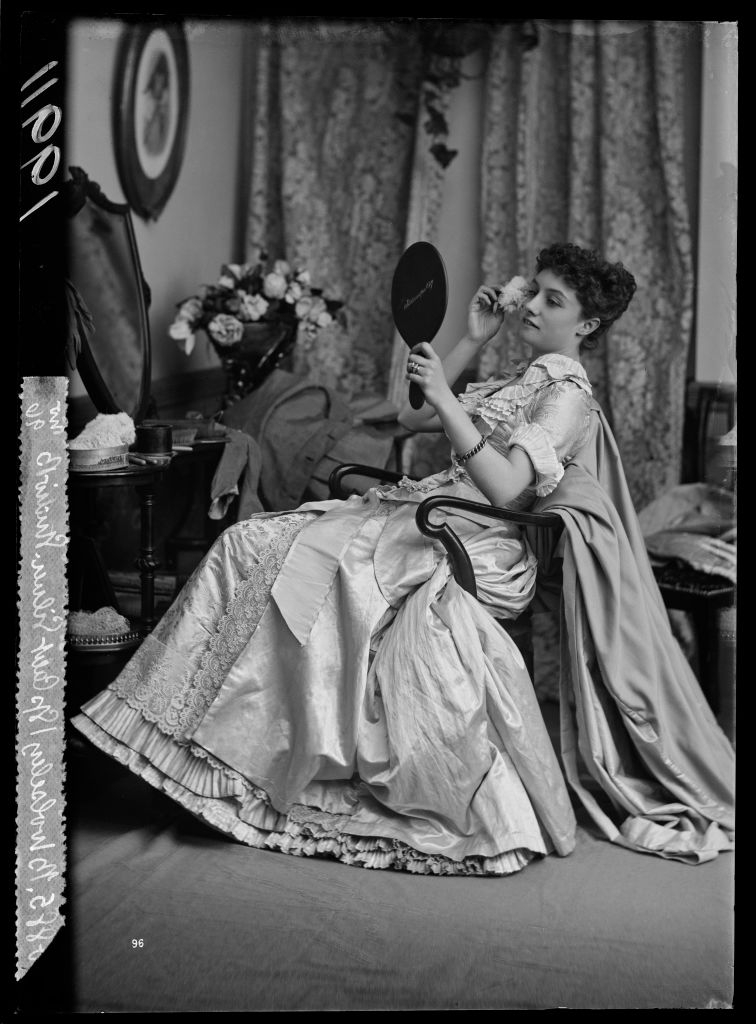
7.Hair brushes and hand mirrors have 48 reported incidents, and the article’s author hopes that “if the wife be at all superstitious, the possibility of breaking the mirror should be a deterrent to its use.”
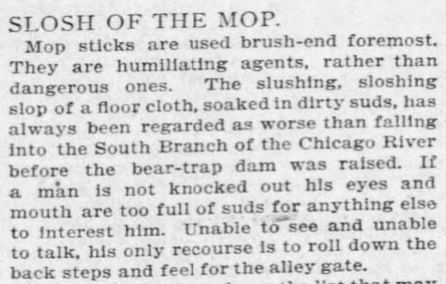
8.Mopsticks, used for 33 attacks, are supposedly “used brush-end foremost,” and the author admits “they are humiliating agents, rather than dangerous ones.”
9.Revolvers, arguably the most dangerous (and obvious) weapon on the list, have 31 reports. It will not come as a surprise that the author said that, based on the reports, women don’t have great aim. Conveniently, however, “when the time for action comes, she can empty a six-chamber revolver rather faster than the garbage pan in the kitchen sink.”
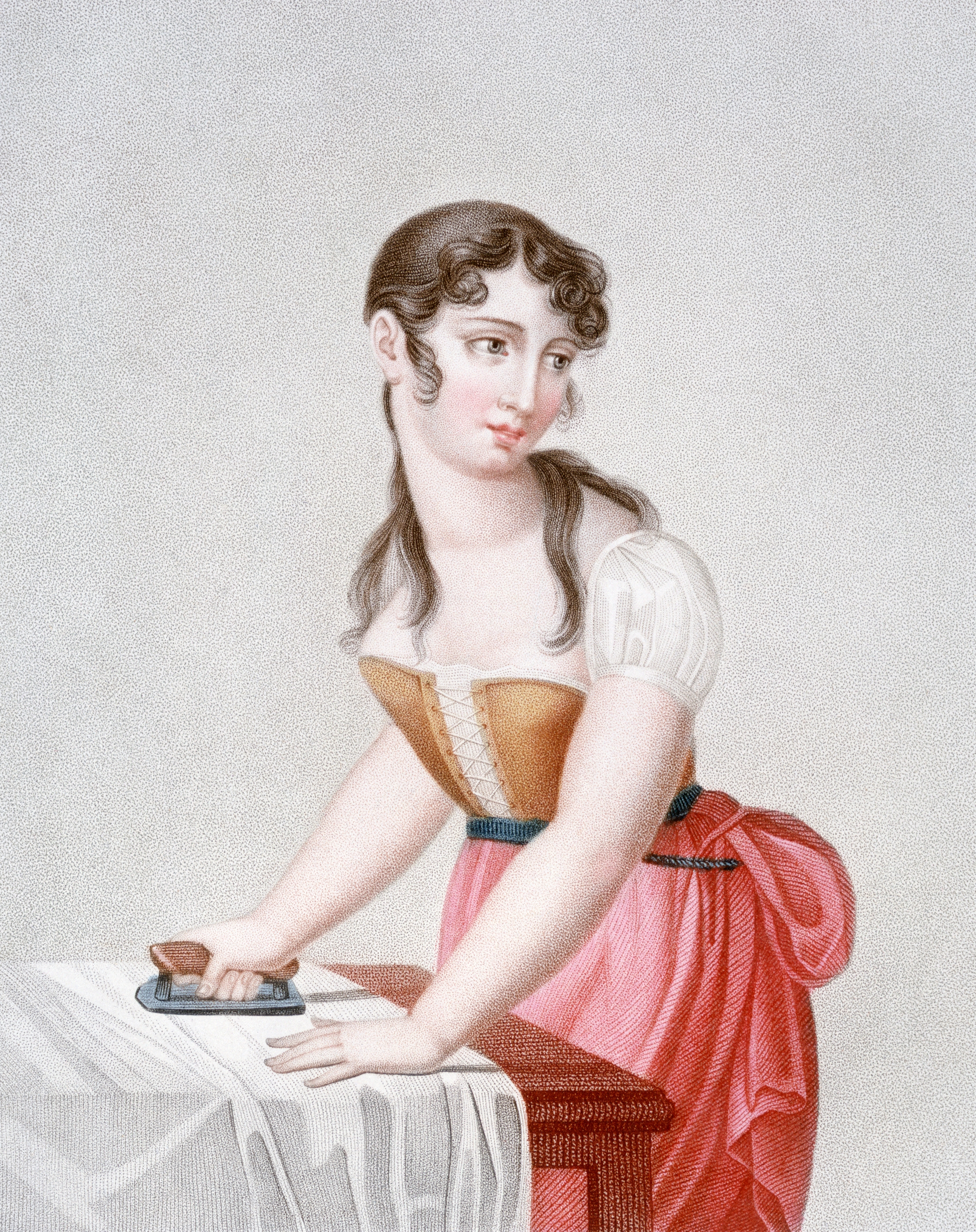
10.Flat irons, which are referring to irons for clothes (not hair), had 29 reports. These were usuallymade of cast iron, and I’d wager they were a pretty easy grab while pressing shirts for someone who had some sideways remarks.
11.Moving on to actual hair tools, curling irons had 12 reports. The author says, “A glancing blow on the sternum, half-circling a lean rib, is a most painful thrust.” These weapons were obviously hot, so they were probably a pretty handy tool for stopping unwanted advances.
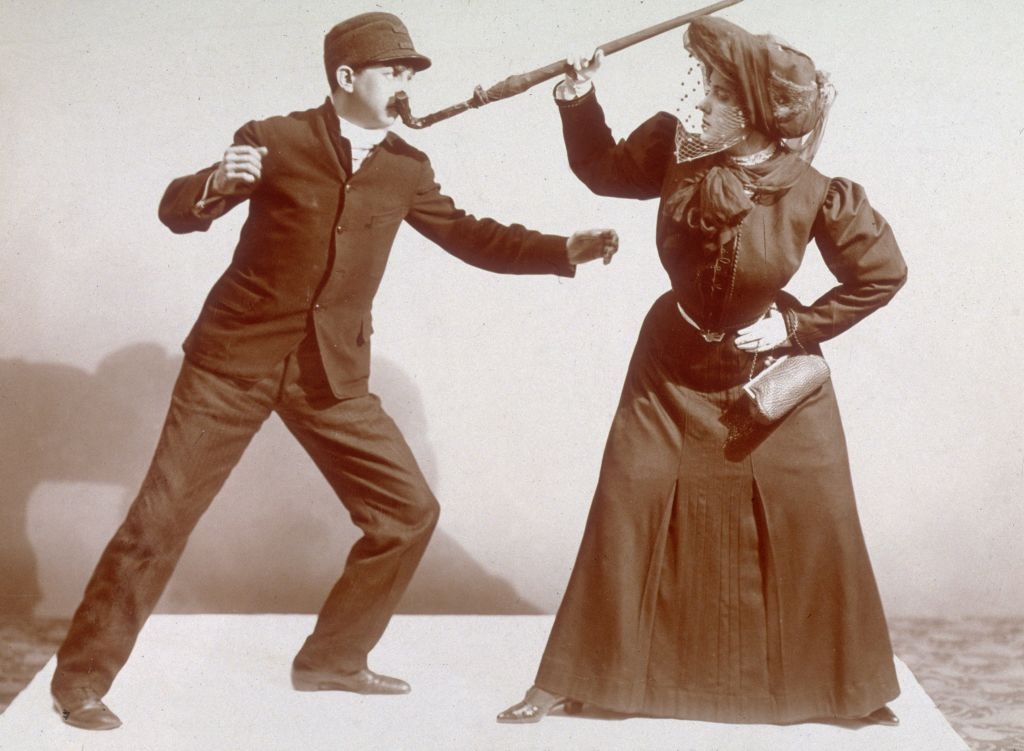
12.Umbrellas and parasols were next with 11 reports. And contrary to the author’s belief, women’s ability to fight back with umbrellas had nothing to do with hysteria — some women actually were trained using them in self-defense.
13.The author says shoes and slippers, which had nine reports, “may be laughed at. A French heel is bad, of course, but a man may close in on the aggressor in all confidence and reduce the whole situation to a rough and tumble mixup.”
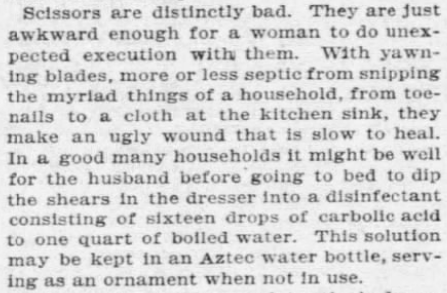
14.Scissors had eight reports, and the author wrote, “they make an ugly wound that is slow to heal,” and suggests that before bed, a husband should “dip the shears in the dresser into a disinfectant of…carbolic acid and…boiled water.”
15.There are only six reports of fork attacks, without additional details in the article. I’ll fill in my personal guess here, which is that the men are busy with dinner, which means fewer women were reaching for the closest pokey thing.
16.Books, the author said, “are almost certain to fly apart, the leaves to spread and flutter, until finally, when the blow lands, it is a good deal like getting a broadside from a Japanese fan.” They also suggest that books, which had only four reports, be “put on racks and chained down.”
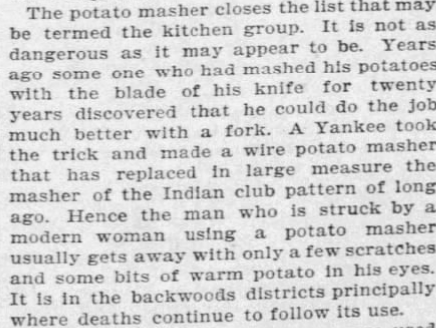
17.Potato mashers had three reports, and the author seems relieved that “the man who is struck by a modern woman using a potato masher usually gets away with only a few scratches and bits of warm potato in his eyes.”
18.Surprisingly, riding whips only have three reports as well. The author says that they were “almost always used on another woman,” and were “invariably selected unless the offense [called] for the use of the revolver.
19.Only a single oil lamp was “thrown,” and the author called lamps “one of the ugliest of domestic missiles,” and said that the target “smells bad for a long time.” They also accuse women of throwing lamps “in the hope of collecting both the life and the fire insurance policies.”
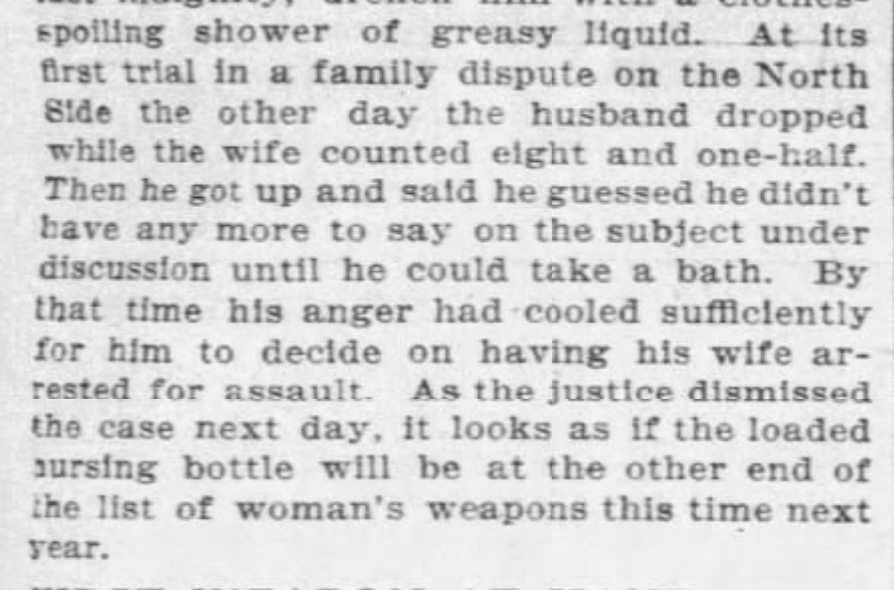
20.And finally, the nursing bottle also had one report. These were made of “glass and rubber,” and the author tells a story of a woman who hit her husband with one, and he then “said he guessed he didn’t have any more to say on the matter until he took a bath.” Afterward, he decided to have his wife arrested for assault. The case was dismissed, so they assert that this weapon will become more popular in the future.
It’s a pretty intense list, but it was Chicago, after all.
Finally, the article closes by saying, “All of this goes to show that if women are not discriminating fighters at all times, they are at least versatile in their choice of weapons. The nursing bottle departure is full of promise that their ingenuity in selection has not reached its limit. There is a great field still open to this talent in emancipated women.”
So , lady : if the need arises , get on out there and do some more inquiry !